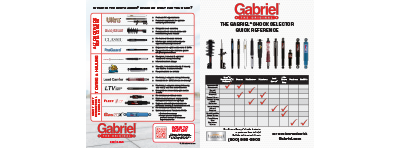



The Front & Rear Spring Assist Load Carrier™ shocks by Gabriel® is the perfect combination of shock and spring technology to help reduce the loss of ride height in ongoing loaded conditions. The constant-rate front coil springs can help improve stability and restore or maintain ride height, while the variable-rate rear coil springs provide 500 lbs. per pair of load capacity**. Front & Rear Spring Assist (Load Carriers) do not increase vehicle payload. In fact, Load Carrier™ shocks were recently rated the #1 shocks for towing!
*by outsidepursuit.com, an avid outdoors & sports activity website. Review published February 8, 2021
**Do not exceed vehicle GVWR
Features & Benefits
BEST rated shocks for towing
D.O.M. (Drawn-Over-Mandrel) Tubing reduces internal wear for longer product life
What do shocks and struts do?
They give you a much smoother ride by absorbing & damping feedback from the road. Ride control, safety & and the ability to steer & brake depend on having firm contact between the vehicle’s tires & the road - good shocks & struts ensure this happens.
What’s the difference between a shock and strut?
Shocks & struts perform a similar function but their design varies. Struts are an integral part of a vehicle’s suspension system. Shocks work separately from any structural function, absorbing and damping the bumps from the road.
Do gas charged shocks or struts contain oil?
Yes, all shocks and struts use hydraulic fluid (oil) to control damping. A gas charged shock or strut uses high-pressure nitrogen gas to reduce oil foaming during high-speed damping, and therefore maintains performance.
My tires are unevenly worn. Do I need to replace my ride control components?
Possibly. There are many factors that can contribute to uneven tire wear; the most common cause is a wheel alignment. Worn ride control components can also contribute. Cupping of the tires is commonly seen as an indicator of worn ride control.
I have a light film of oil on my shock, does it need to be replaced?
Probably not. Shocks are designed to "mist" slightly & this film helps lubricate the seal as the piston rod moves. A light uniform misting is normal, but streaking patterns aren't and should be investigated. Remember: If it's streaking, it's leaking!
When should I replace my shocks?
Generally, Gabriel® recommends replacing your shocks or struts at regular 50,000-mile intervals to ensure a safer and more comfortable ride in most vehicles. Actual mileage intervals may vary based on vehicle specs, use, and environment.